

Use Lepaya's skills gap analysis tool to uncover the critical skills your teams require.
Start now


.jpeg)
TL;DR: By 2030, 39% of today's core workplace skills will need to change. The World Economic Forum's Future of Jobs Report identifies 10 skills that are both critical right now and growing fastest in importance, spanning AI literacy, cognitive skills, resilience, leadership, and talent management. This article breaks all 10 down by category, explains why each matters, and gives L&D and HR teams concrete actions to start closing the gaps today.
Every two years, the World Economic Forum releases its Future of Jobs Report, the most comprehensive global mapping of where work is heading. In the 2025 edition, the report projects that 170 million new roles will emerge by 2030, while 92 million existing positions will be displaced. These changes in the global labor market will require people to have different skills than they do today.
So what skills are in demand in the near future? And what does a realistic upskilling strategy look like in 2026?
In this article, we’ll break down the top 10 future-proof workplace skills, why they are important, and what L&D professionals can do to prepare for the Reskilling Revolution.
According to the World Economic Forum, by 2030, 39% of workers’ core skills will change. This is because four forces are reshaping the global skills agenda, and they all point in the same direction: the organisations that invest in continuous development now will be better placed to compete.
The pace of AI adoption has accelerated significantly. 86% of employers surveyed by the WEF expect AI and information processing technologies to transform their businesses by 2030 — making it the most-cited technology trend by a wide margin, ahead of robotics (58%) and energy storage technologies (41%).
As AI takes on more routine cognitive tasks, demand for higher-order human skills is growing in parallel. The two are not in opposition; they reinforce each other.
It will come as no surprise that the global pandemic has had a huge impact on the way we work. But in recent years, other factors such as the shift to hybrid and flexible working, the rise of the green economy, and increasing expectations around DEI (diversity, equity, and inclusion) have further accelerated changes in how organizations operate, and what skills they need to do it. As existing roles evolve and new ones emerge, the skills required to perform them are changing with them.
Not so long ago, skills were valid for about five years, but nowadays, many skills are outdated after only two years. This is the skills gap: employees lack the capabilities they need to continue performing their jobs well as the world around them changes.
According to the Future of Jobs report, 63% of employers identify skills gaps as the single biggest barrier to business transformation through 2030. A recent Lepaya panel discussion reinforced this: when asked, two-thirds (66%) of L&D leaders reported already seeing skill gaps widening in certain areas of their organizations.
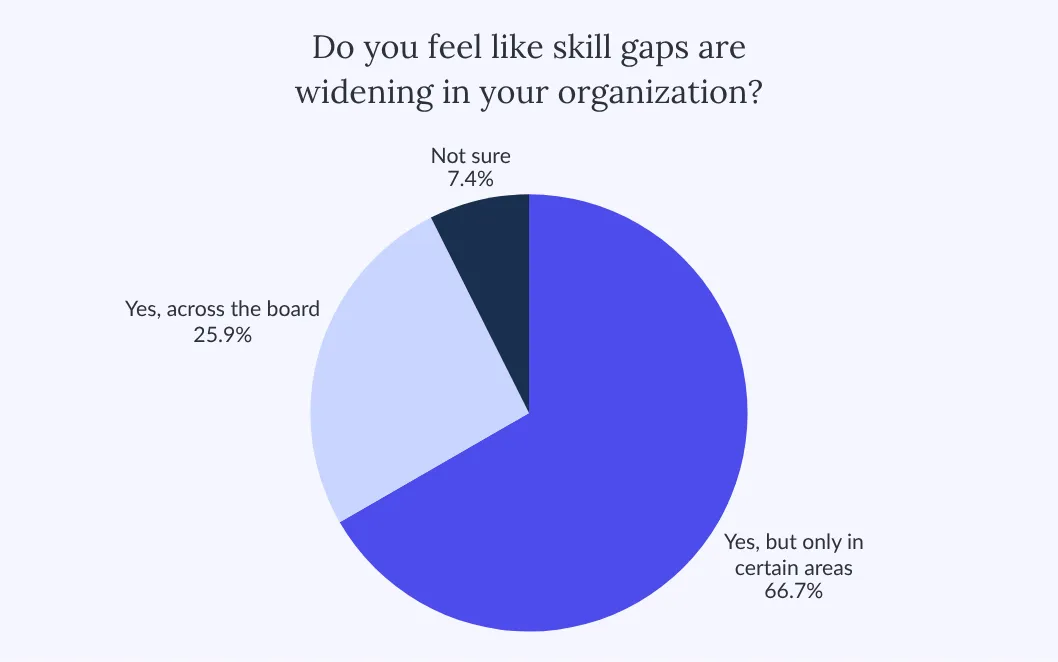
Closing this talent gap is critical to an organization’s success. 85% of employers now plan to prioritize upskilling their workforce as their primary response to market changes, with 70% of employers expecting to hire staff with new skills, 40% planning to reduce staff as their skills become less relevant, and 50% planning to transition staff from declining to growing roles.
Employee happiness and skill development are more connected than they might appear. When people feel they are growing professionally - building capabilities, gaining confidence, moving in a direction that means something to them - they are more engaged, more motivated, and more likely to stay. That is not a nice-to-have; it reflects a fundamental human need to develop and progress.
Beyond personal fullfilment, continuous learning has also become a practical necessity. The working world is changing fast, and the people who thrive in it are the ones who actively build skills rather than wait for their existing ones to carry them through. Whether the goal is adapting to new technologies, taking on broader responsibilities, or contributing meaningfully to a more innovative and inclusive organization, self-development is the common thread. Future-proof skills are not just good for your career; they are what make it possible to show up well in the roles that will matter most over the next decade.
To anticipate the challenges and opportunities both companies and employees will face in the near future, the WEF has identified the workplace skills that are both critical for employers right now and growing fastest in importance through 2030. These are the skills where the gap between supply and demand is widest, and where investment will have the highest return.
Here are the top 10 future-proof workplace skills:
These 10 skills fall across five categories: technology skills, cognitive skills, self-efficacy, management skills, and working with others. Together they represent the full picture of what employers will need from their workforce by 2030, and what any serious L&D program should be building toward.
AI and big data is the fastest-growing skill in the entire WEF survey. This does not mean every employee needs to build AI models. It means every employee needs to understand how AI tools work, what they can and cannot do, and how to use them effectively in their day-to-day work. Organisations that build AI skills across the workforce now will have a meaningful productivity advantage over those that treat it as a purely technical concern.
Technological literacy goes hand in hand with AI fluency: it is the broader ability to work confidently with digital tools, platforms, and data. Both skills are growing because technology adoption is outpacing the ability of most workforces to use it well, and closing that gap is one of the most direct levers L&D teams have.
Actions L&D and HR can take:
Three cognitive skills make the top 10: creative thinking, analytical thinking, and systems thinking. These are not new skills, but they are growing in importance precisely because AI is handling more routine cognitive tasks, making the higher-order human skills more valuable.
Analytical thinking remains the most widely demanded skill among employers today.. Creative thinking, the ability to generate original ideas and approaches, is growing fastest in industries like insurance, education, and telecoms. Systems thinking, which involves understanding how the parts of a complex system interact, is increasingly critical as organisations manage more interconnected technologies, teams, and processes.
The most common mistake organisations make is treating these as innate traits rather than learnable skills. All three can be developed with the right program design.
Actions L&D and HR can take:
Resilience, flexibility and agility; curiosity and lifelong learning; and motivation and self-awareness are the three self-efficacy skills in the top 10. These are the cognitive and emotional foundations that determine whether people can keep pace with the rate of change the next five years will demand.
Resilience is not just about coping with setbacks; it is about maintaining performance and focus when conditions shift, roles evolve, or technologies change the nature of the work. Curiosity and lifelong learning are what keep people relevant: the willingness to actively seek new knowledge rather than assume that what worked before will continue to work. Motivation and self-awareness, meanwhile, are the capacity to understand your own strengths and development areas and direct your energy accordingly.
One factor that reinforces all three is a growth mindset, the belief that abilities can be developed through effort and experience, rather than being fixed traits.
Actions L&D and HR can take:
Leadership and social influence sits in the top 10 fastest-growing skills, and its presence reflects something important: as AI takes on more routine cognitive work, the skills that are distinctly human are becoming more valuable, not less. The ability to communicate, inspire, resolve conflict, and drive alignment across teams cannot be automated. In hybrid and distributed organisations, it is also harder to develop passively, it requires intentional programme design.
This is one of the skills with the largest increase in employer demand since the 2023 WEF report. Lepaya’s The State of Skills 2026 report, which analyzed learning data from 196 global companies, also found that empowering leadership training has surged by 126% from 2024 to 2025, and now accounts for over half of all training investment.
For L&D, this represents both an opportunity and an obligation: mid-manager capability is where the leverage is highest and where most organisations underinvest.
Actions L&D and HR can take:
Talent management is the management skill in the top 10, reflecting a broader truth: as the skills landscape shifts rapidly, the ability to identify, develop, and retain the right people is itself a critical competitive capability. Managers who can spot emerging skill gaps, coach team members through transitions, and make good decisions about who to develop and how are directly contributing to organisational resilience.
As more jobs are affected by AI and automation, talent management also increasingly means managing the human side of that transition, helping people understand how their roles are changing, building confidence alongside new technical skills, and maintaining engagement through uncertainty.
Actions L&D and HR can take:
Skills gaps are what most commonly hold organisations back — not lack of ambition, not lack of strategy, but the simple reality that the people doing the work do not yet have everything they need to do it well in a changing environment. Closing those gaps is not a one-time effort. It requires a genuine, ongoing commitment to developing your people — one that sits at the centre of your business strategy, not at the edges of it.
When that commitment is absent, the consequences are predictable. People who cannot see a path forward within an organization will find one elsewhere. In a labour market where skilled talent is genuinely hard to find and even harder to replace, attrition is expensive — in recruitment costs, in lost knowledge, and in the momentum that walks out the door with every departure. Investing in your people's development is one of the most direct levers you have for building the kind of loyalty and engagement that retention strategies alone cannot create.
Getting there requires more than a training budget. It requires alignment. Leaders, HR teams, and managers all need to understand why these skills matter, not just in abstract terms, but in the context of your specific business: what it is trying to do, where the gaps are, and what developing these capabilities will make possible. When that shared understanding exists, development programmes stop feeling like a compliance exercise and start functioning as a genuine driver of performance.
So where do you start?
Tomorrow’s success will require new and different skills. And that’s a good thing. It keeps us fresh and focused on the future.
At Lepaya, we train employees with the right skills at the right time and in the right way, so that they can make the most out of their professional and personal lives. Helping companies and their employees develop their future skills is part of our DNA. In our most recent Lepaya Skills Monitor, published in October 2021, we were curious about the following: How do Dutch employees rank themselves on the key skills of the future?
We surveyed 1.065 professionals and asked them how they rated themselves on eight key skills that we feel are necessary in order to continue their job well, now and in the future. Curious? You can read the results here.

We offer a scalable employee training solution. It lets you continuously upskill your people.
Book a call


.webp)
Review by:
Caner Akova, L&D Manager at Olympus, shares how L&D leaders must evolve from training providers to strategic problem-solvers who speak business language, address root causes of performance gaps, and drive measurable business outcomes.
Close skill gaps, accelerate growth, and future-proof your workforce.




.webp)

.webp)