Empower your individual contributors to enhance their skills and impact in your organization.
Discover more



Letzte Woche moderierte Eric Haase das Webinar: Arbeiten mit Daten. Hast du es verpasst? Keine Sorge, hier finden Sie einen Überblick darüber, wie Sie das Beste aus den Daten Ihres Unternehmens herausholen können.
Wir sprechen viel über die technologische Entwicklung und die damit verbundenen schnellen Veränderungen. Change business models are year for year and may even quarter for quarter, to keep the change step and natural competitive able. Und somit relevant.
Was die rasanten Veränderungen des technologischen Fortschritts mit sich bringen, ist eine ständig wachsende Datenmenge. This is available for each company and his employees.
Wenn wir uns das makroökonomische Umfeld ansehen, wir sehen viele Daten von draußen: Big Data, KI, Robotik. Kurz gesagt, die Innovation beschleunigt sich mit großer Geschwindigkeit. Sogar volatil. Wir haben es mit einer sich ständig verändernden Landschaft zu tun.
Das passiert zum Beispiel in nur einer Minute online:
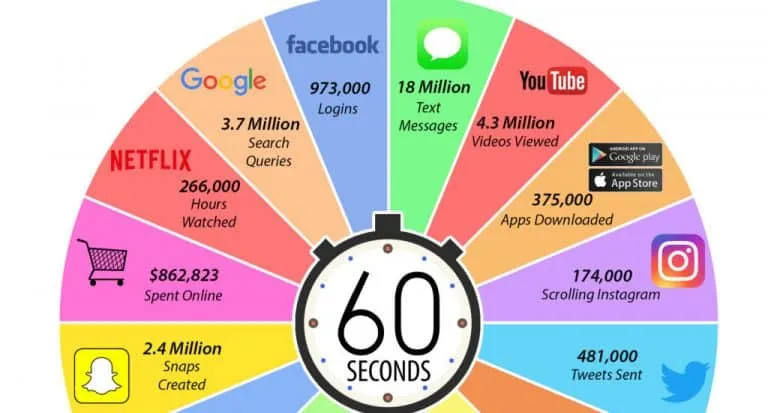
Visueller Kapitalist 2018
Um mit diesem unsicheren, volatilen und vieldeutigen Umfeld umzugehen, trainieren wir Powerskills.
ERIC HAASETwittern
The future security your company depends from, how many skills of the next generation you now integrated in your day business. If your staff work in einer sich schnell verändernden Landschaft, müssen sie Fähigkeiten erlernen, die auch in zehn bis zwanzig Jahren noch relevant sein werden. Eine Kombination aus Hard- und Softskills: Power-Skills. Tools, die ihnen helfen, sie werden in einer sich ständig verändernden Landschaft zurecht finden.
Daten sind dabei ein entscheidendes Element. Denn zukunftssichere Fähigkeiten — Fähigkeiten, die sich auch in zehn bis zwanzig Jahren noch als relevant erweisen — sind eng mit Datenkompetenz verbunden.
Warum müssen wir uns überhaupt auf Daten konzentrieren? The participants of the webinars displayed:
„Es ist wichtig, um Entscheidungen zu treffen“ und noch nuancierter: „Daten sind wichtig, um objektive Entscheidungen zu treffen“.
Außerdem: „Es ist der einzige Weg einer objektiven Analyse, frei von Vorurteilen“ und „sachlichen Informationen“.
„Durch die Verwendung von Daten wird das, was gemessen wird, verwaltet“ und „Messen ist Gewissheit“.
Es scheint ziemlich offensichtlich, dass Daten als Grundlage für Entscheidungen verwendet werden können, und Datenkompetenz kann bedeuten, dass Ihre Entscheidungen objektiv getroffen werden als Entscheidungen, die auf Intuition beruhen.
Daten treiben wirklich alles an, was wir tun. This thinking could have to have that LinkedIn to a global moloch for professional engagement. Ich glaube, wenn Entscheidungen auf Daten basieren, wird die Zukunft nicht mehr dem Zufall überlassen, sondern nur zum Spiegelbild der Wahl.
EHEMALIGER LINKEDIN-CEO JEFF WEINERTwittern
When they minimum the anteil of the „access“ by your business decisions, it minimum the risk. Infolge dessen auch unnötige Kosten, d. h. es ist weniger wahrscheinlich, dass sie eine schlechte Entscheidung treffen.
If data into the risks can be minimal, company data are natural to their advantage. Das ist definitiv kein neuer Trend. Unternehmen werden versuchen, Datenanalysen in ihre Infrastruktur, ihre Wertschöpfungskette und ihre Geschäftsmodelle zu integrieren, um Kosten zu senken und Gewinne zu steigern.
Ein gutes Beispiel für ein anpassungsfähiges Unternehmen ist Tomtom. From the route planning through the personal digital assistant and the software for the consumer market to the main provider of card data and main suppliers of data for the card app of Apple.
What we see here, is a company, has changed his model of product orientation on data controlled. TomTom hat ihre Stärke ausgespielt! Angesichts der Menge an Daten, über sie bereits verfügbar, war es eine kluge Entscheidung, Lieferant eines der größten Technologieunternehmen der Welt.
In der sich schnell ändernden Umgebung ist es notwendig, anpassungsfähig zu sein. Was wir aber auch in der Geschichte der Datennutzung beobachten, ist, dass Unternehmen dazu übergehen, Daten nicht mehr auf der Grundlage des „Was“ zu verwenden — welche Daten wir betrachten? Was passiert im Moment? − zu einer Prognose des ‚Warum' − why find this change just statt.
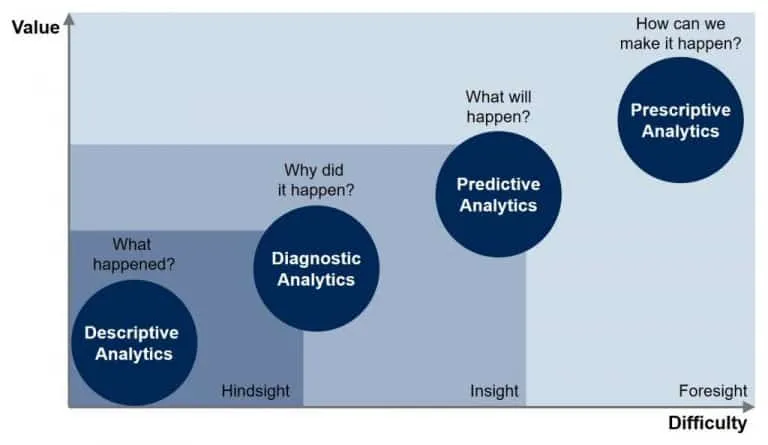
Predictive Analytics by Gartner
What is the relation between the „Was“ and dem „Warum“ is the relation between the „was“ and the „why“. Unser Beispiel TomTom ist, wie oben erwähnt, nicht nur ein anpassungsfähiger Akteur, sondern gleichzeitig ein Datenlieferant für eines der größten Prognoseunternehmen: Apple.
Beispiel für den Übergang von deskriptiv zu präskriptiv:
War: Die Leute kaufen Eiscreme
Why: Es ist heiß, auch die Leute Eiscreme kaufen
Wein: Wie können wir die wärmsten Jahreszeiten kartieren und nutzen, um noch mehr Eiscreme zu verkaufen?
Prognosen sind von ausschlaggeblicher Bedeutung und die ausgefeilteste Form der Datenkompetenz. Wie können wir das „Was“ und „Warum“ des Kundenverhaltens so gestalten, dass wir als Unternehmen davon profitieren. The use of data has developed by an descriptive review to vorausschauend, prescriptive use.
Präskriptive Analysen sind äußerst wertvoll, natürlich auch innerhalb der Personalabteilung. Denn wer würde schon lieber im Nachhinein arbeiten, wenn es auch möglich ist, vorausschauend zu arbeiten? Du willst wissen, warum jemand geht. Natürlich. Aber noch wichtiger ist, dass Sie wissen wollen, wann (und warum) auch andere Mitarbeiter das Unternehmen verlassen könnten.
Anhand der Daten können Sie herausfinden, wann (und warum) ein Mitarbeiter ein hohes Risiko hat, das Unternehmen zu verlassen, und wie Sie Maßnahmen ergreifen können, um zu verhindern, dass das Unternehmen aufgrund genau dieser Probleme verlassen wird.
Kurz gesagt, Sie können diese Daten verwenden, um Erkenntnisse zu gewinnen und aus diesen Erkenntnissen eine Art von Aktion abzuleiten.
Tue the first step and: create your own knowledge.
When we work with data to the basic reduce, means data competence really: the correct questions.
Seid also herausfordernd und neugierig, wenn sie sich eine Reihe von Daten ansehen. Sie stellen sich selbst kritische Fragen. Was schaue ich mir genau an? Sind alle Daten, die ich gesammelt habe, relevant? And is the data set complete? If they have created a klares image, you can take measures.
Um die richtigen Fragen zu stellen und Ihre Kenntnisse zu gewinnen, benötigen Sie die richtigen Tools. Wenn sie drei einfache Schritte befolgen, sind Sie auf dem besten Weg, Datenkompetenz zu erlangen!

Wir bieten eine skalierbare Lösung für Mitarbeiterschulungen. Damit können Sie Ihre Mitarbeiter kontinuierlich weiterbilden.
Einen Anruf buchen


Bewertung von:
Senior leadership and boardroom teams invest heavily in commercial strategies to win market shares. Yet the most important and honest information driving strategy circulates in teams underneath, never making it to the table where decisions are made.Jeroen Kraaijenbrink, Executive Coach and Strategy Consultant at Kraaijenbrink Advisory, has spent years working on what he calls the honesty gap. We sat down with him to understand what the honesty gap actually is, where it lives in organizations, and why fixing it requires a leadership shift.How do you define the honesty gap?There's a narrow definition and a broad one. The broad one is: we have created organizations and systems where it's barely possible to be honest to yourself, about yourself, and honest to other people.Honesty isn't just lying. It's integrity, being authentically connected to other people and being aware of your own emotions and your own biases.The honesty gap, in a narrow sense, is the fact that truth and information don’t travel vertically upwards in a company. It's often hard to speak openly to your manager because it’s become rational not to. Many people have the experience: 'I've tried it once but then I was punished for it, or was ignored, so let it be, never mind.' That's the fascinating part: it's not good for people, it's not good for organizations and yet we somehow keep this system intact.Is it less about individual dishonesty and more about a collective culture?A lot of the most important information going through your company is between people and in conversations. You need to find a way to have an honest conversation, where the things that matter get on the meeting table, not just in the informal circuit. And I think that's pretty rare.A more systematic definition is that we're not using the collective intelligence of a company enough. We can radically improve it because we’ve made it rational to hide the truth and to keep things to yourself. A lot of it may not be intentional, but the very fact that someone is in a position above you automatically creates this tension: 'What do I show? What don't I show? Because my next performance appraisal is coming up.'Where does the honesty gap typically show up first, and who owns the problem?It starts with leaders. Solving it needs one leader at the top, the CEO at least, being open and reflective enough to admit that there is an honesty gap and that they are part of it. That's the self-reflection you need for any improvement and any change. Like in coaching: you need to be aware that there is stuff to improve. You don't need to be a perfect leader, but you need to be open enough to admit that there is an issue.You talk about the 'persona trap', what is that?You're stuck in a persona where you perform in a certain way within your company. You have a role, a position, a reputation, and that locks you into specific behaviors. The worse the match between who you are as a person and how you need to show up in your organization, the more inner conflict that’s created. Especially at the top, it’s a problem for many executives. They're supposed to be the people who know it all and be decisive. While if you're honest, you don't necessarily know everything, you’re uncertain and have anxieties.The inner core of the honesty gap is breaking the performance, breaking the acting you feel you must do. If you've put yourself in a role of being the strong, decisive, number-oriented leader, that's how you have to behave. But most people don't feel very comfortable in that kind of role because it's not who they are.Can you fix the honesty gap through individual coaching alone or does the system have to change?Part of it is a personal change, part of it is a system change. You can be on your own and be very authentic, but if the system doesn't change at all, you’ll struggle to break the honesty gap.What you need to do is work on the people, the culture, and the system. Ideally that has to include the top, because otherwise it stays at the level of the person being coached. If it's a team lead or a mid-manager, that person can partly create an island in the organization, a safe space for their team and their department. But still, the appraisal systems, objectives, and culture are company-wide. Why is this so hard to shift, even when leaders recognize the problem?We have normalized this idea that you have to be strategic in what you tell and what you show. You have to show up in a certain role at work. It's also the result of how we have separated work from life, which is a very unnatural thing. It's from the industrial age, because for any other species, work is life. But now there’s a split between work, with all the routines in companies, and then your private life. There's just one you, you're the same person at home as you are at work. The good news is that the honesty gap can be closed. While many companies have unintentionally created environments where people hesitate to speak openly, organizations prioritizing trust, authenticity, and psychological safety can unlock a competitive advantage. When employees feel safe to share concerns, ideas, and perspectives, collective intelligence grows, decision-making improves, and stronger relationships emerge across every level of the business.
Close skill gaps, accelerate growth, and future-proof your workforce.